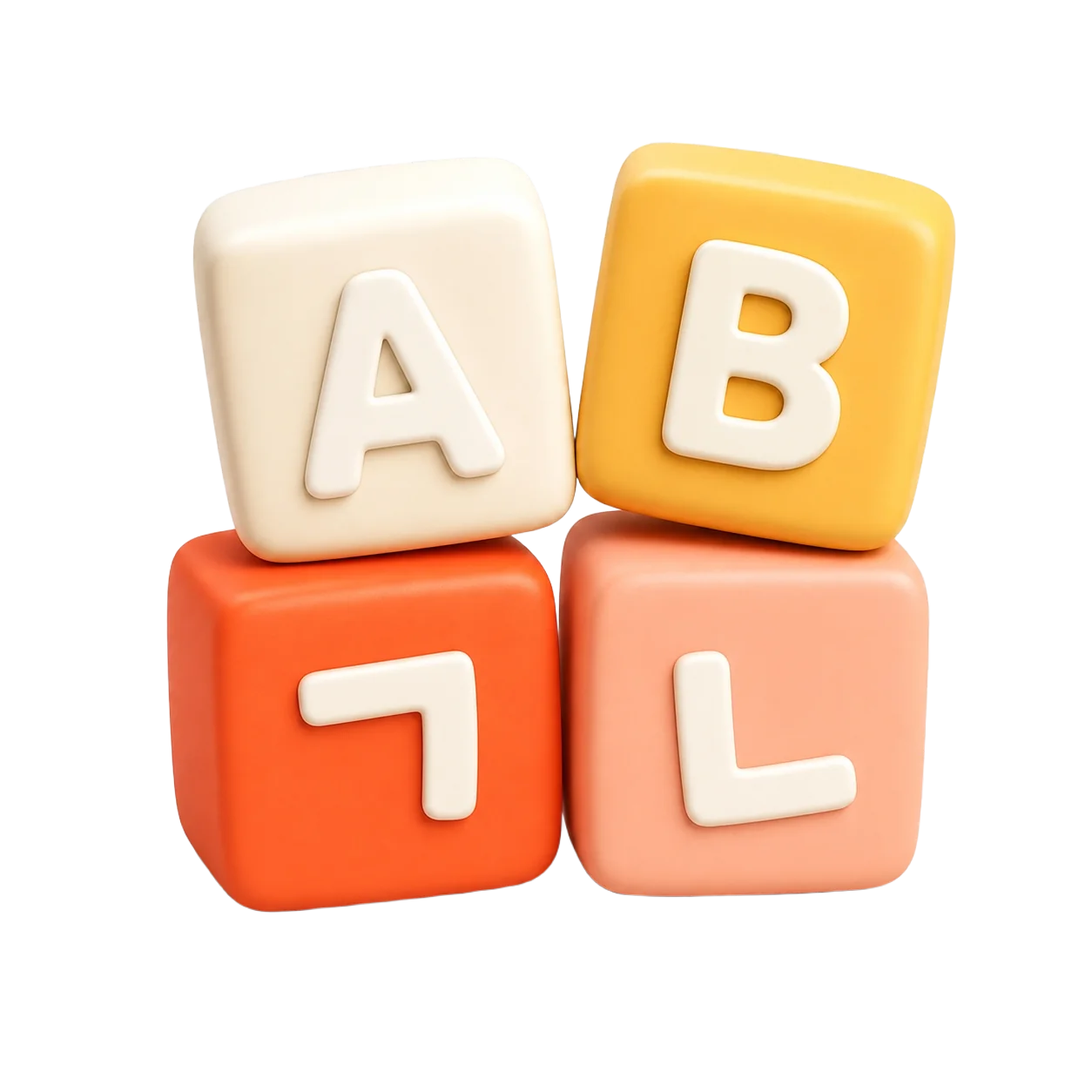
Build Korean and English Words with Blocks
Let children combine letters before asking them to memorize words
Place Korean ㄱ and ㅏ together to make 가, or line up c, a, and t to make cat. Moving each piece helps a child see that a written word is built from smaller sound parts whose order matters.
Tangobook's block play works with on-screen pieces, so no block set is required. Families who have physical Korean or alphabet blocks can continue the same activity in camera mode.

Korean blocks bring a consonant and vowel into one syllable
Hangul groups letters into a syllable block. Begin with a clear combination such as ㄱ plus ㅏ. Point to each piece, say its sound, then read the completed 가.
Once that pattern is familiar, change only the consonant to make 나, 다, or 라, or change only the vowel to make 거, 고, or 구. Put out only the pieces needed for the current turn so the choice stays manageable.
For English, blend sounds instead of reciting letter names
When building cat, say the short sounds /k/ /a/ /t/ and slide them together. Hearing the word emerge shows why the order of the blocks matters.
Start with short words of two or three letters. If the final sound disappears, point to the last block and blend once more. Keep attention on the sound of each piece before correcting spelling.
Practice on screen, then rebuild with physical blocks
Use the on-screen pieces to learn the pattern first. After completing one word, find the same letters in a physical block set and place them on a table. Tangobook's camera mode connects the arrangement made by hand with the activity on screen.
- Build today's word once on screen.
- Choose only the physical pieces you need.
- Point to the finished word and read it.
- Change one first letter or vowel and try a new word.
Read an incorrect arrangement before fixing it
If the pieces are out of order, sound them out as they are. When the result differs from the intended word, ask which piece should move.
Questions such as "What does it sound like now?" and "Which block could we change?" make revision part of the game. Once a word is complete, connect its meaning with a picture, object, or gesture.
Frequently asked questions
Do we need physical blocks?
No. The screen mode is ready to use by itself. Camera mode is an extra option for families who already have Korean or alphabet blocks.
Can we practice Korean and English in one session?
You can, but one language at a time makes each writing system's pattern easier to see. Switch only if your child wants another round.
What if camera recognition is difficult?
Keep blocks separate, use even lighting, and make sure the camera can see the whole arrangement. You can continue the same practice in screen mode at any time.
Start on screen, even without a block set
Choose Korean or English, then use screen blocks or connect physical blocks with camera mode.
🧩 Start block play →